
What Is Stoicism? (And What It Isn't)
Stoicism has a branding problem. Here's what the philosophy actually says — and why the popular idea of a 'stoic' person gets it almost backwards.
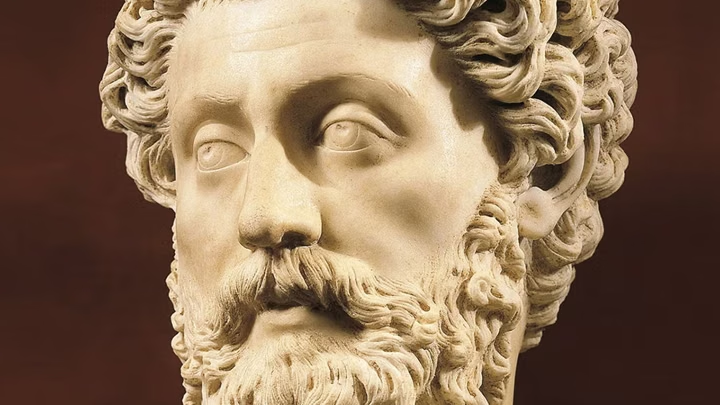
In 170 AD, somewhere along the frozen Danube frontier, a Roman emperor sat in his command tent and wrote a single line to himself: that the obstacle in front of him was not a disaster, but material — something to be worked with, not simply endured.
Marcus Aurelius was not a philosopher by profession. He was the most powerful man in the known world, fighting a war he didn't want, grieving children he'd lost, managing a court full of people who wanted things from him. And every night, by lamplight, he wrote himself notes — reminders, really — on how to stay clear-headed and decent in the middle of all of it. Those notes became Meditations, one of the most quietly influential books ever written, and they weren't meant for us. They were meant to keep one exhausted man honest with himself.
That's Stoicism at its root. Not a performance of toughness. A private discipline for staying rational and steady when everything around you is not.
What the Word Actually Means
Somewhere between ancient Athens and modern English, "stoic" got demoted from a philosophy to an adjective — and a fairly cold one. Say someone is "being stoic" today and you probably mean they're suppressing feeling, gritting their teeth, refusing to show anything at all.
The actual philosophy is almost the opposite of that.
Stoicism began around 300 BCE in Athens, founded by a merchant named Zeno of Citium who, according to tradition, lost everything in a shipwreck and ended up in Athens with nothing to do but sit in on philosophy lectures. He eventually started teaching from a public colonnade — a stoa — which is where the name comes from. It's a philosophy that was literally born in public, in the middle of the marketplace, not withdrawn from life but built for people living squarely inside it.
The core claim is fairly simple: your wellbeing depends far less on what happens to you than on what you do with what happens to you. Events themselves are neutral. Your judgments about them — and your responses — are where all the actual living takes place. That's not a call to numb yourself. It's a claim that you have far more agency over your own experience than you usually act like you do.
Three Things Stoicism Is Not
It's not emotional suppression. The Stoics wrote extensively about grief, anger, and fear — because they felt them. The goal was never to feel nothing. It was to stop being ruled by reactions that don't actually serve you, and to feel the right things, at the right intensity, for the right reasons.
It's not passive acceptance of everything. "Focus on what you control" gets flattened into "don't try to change anything," which is backwards. The Stoics were generals, senators, advisors, and reformers. The philosophy was a tool for acting more effectively, with less wasted energy on outrage and despair that changes nothing.
It's not a relic. The ideas have quietly shaped modern psychology more than most people realize — cognitive behavioral therapy, for instance, borrows directly from the Stoic idea that it's our interpretations of events, not the events themselves, that drive our distress.
The One Idea Worth Starting With
Of everything the Stoics wrote, one distinction does more practical work than almost anything else: the difference between what is up to you and what is not up to you.
Your judgments, your effort, your integrity, how you treat people — up to you. Other people's opinions, the outcome of a job interview, whether it rains on your wedding day, what the market does tomorrow — not up to you.
Most of our daily suffering comes from investing our peace of mind in the second category as if it belonged in the first.
Try This Today
Pick one thing that's been sitting heavy on your mind. Write it down. Then, next to it, write two honest lists: what about this situation is actually within your control, and what isn't.
Most people find the first list is shorter — and far more actionable — than they expected.
A question for your notebook: Where have you been spending emotional energy this week on something that was never yours to control in the first place?
That question, asked honestly and often, is most of what Stoic practice actually is.